
Web3 Application Penetration Testing
Smart contract auditing plus frontend-to-blockchain testing to prevent logic flaws, rug pulls, and liquidity drainage.
I) Introduction
Definition
A Web3 Penetration Test is a comprehensive security assessment of a decentralized application (dApp). It is a hybrid methodology that evaluates three core components:
- The Frontend: The web or mobile interface that users interact with.
- The Backend (Off-Chain): Traditional APIs, servers, and infrastructure (e.g., RPC nodes) that support the dApp.
- The Smart Contracts (On-Chain): The immutable business logic deployed to a blockchain (e.g., Ethereum, Solana, Polygon).
Primary Goal
The goal is to identify and exploit vulnerabilities across all three components. The primary focus is often on the smart contracts, where flaws can lead to irreversible, catastrophic financial loss (e.g., draining a protocol's treasury). The test simulates attacks from malicious users, external attackers, and even network-level actors (e.g., miners/validators).
Guiding Frameworks
This methodology is guided by:
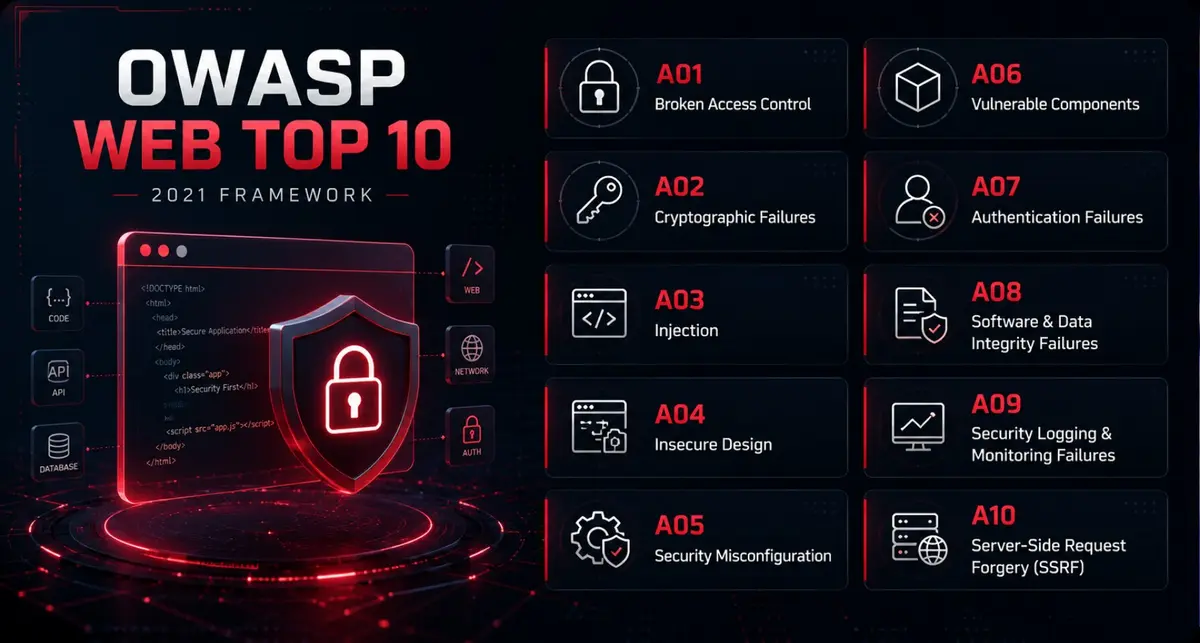
- OWASP Web Top 10: For the frontend and off-chain API components.
- Smart Contract Security Guidelines (e.g., SWC Registry, Smart Contract Weakness Classification): For the on-chain code.
II) Penetration Test Phases
Phase 1: Planning and Scoping
 Phase 1: Planning and Scoping
1.1. Define Objectives
- Clearly define the goals (e.g., "Drain funds from the treasury," "Mint unauthorized NFTs," "Take over governance," "Access another user's data," "Impersonate the admin").
1.2. Define Scope
- Smart Contracts (On-Chain):
- The specific GitHub commit hash(es) of the source code to be audited.
- The on-chain addresses of all deployed contracts (on testnet and mainnet).
- Frontend (Client-Side): In-scope URLs for the dApp (e.g., https://app.example-defi.com).
- Backend (Off-Chain):
- In-scope API endpoints (e.g., https://api.example-defi.com).
- In-scope RPC (Remote Procedure Call) nodes, if self-hosted.
- Out-of-Scope:
- The Blockchain Itself: (e.g., Ethereum, Solana).
- Third-Party Wallets: (e.g., MetaMask, Phantom).
- Third-Party Protocols: (e.g., Uniswap, Chainlink) unless the integration with them is the focus.
1.3. Establish Rules of Engagement (ROE)
- TESTNET & FORKS: CRITICAL: All active exploitation and testing must be performed on a specified testnet (e.g., Sepolia) or a local fork (using tools like Hardhat or Foundry).
- MAINNET IS OFF-LIMITS: No active, exploitative testing is permitted on the main production network.
- Credentials: Test accounts (with testnet funds) must be provided for all user roles.
- Communication Channels: A direct line to the development team for critical findings.
Phase 2: Reconnaissance
 Phase 2: Reconnaissance
Gathering information about all three components of the dApp.
2.1. Frontend & Backend Reconnaissance
- Standard Web Recon: Use traditional tools (nmap, dirb, Burp Suite) to map the web app, find hidden directories, and identify running technologies (e.g., React, Node.js).
- OSINT: Review GitHub, documentation (whitepapers, developer docs), and social channels (Discord, Telegram) to understand the architecture and find potential leaks.
2.2. Smart Contract Reconnaissance (On-Chain)
- Block Explorers: Use tools like Etherscan (or PolygonScan, etc.) to:
- View the verified source code of the deployed contracts.
- Analyze the transaction history. Who is interacting with the contract? How often?
- Identify all contracts in the "ecosystem" (e.g., Token, Staking, Governance).
- Automated Tools: Use tools like Slither or Mythril to perform an initial, high-level static analysis of the source code to find "low-hanging fruit."
Phase 3: Vulnerability Analysis
 Phase 3: Vulnerability Analysis
This is the core execution phase, broken down by component.
3.1. Frontend (Client-Side) Testing
- OWASP Top 10: Test for all standard web vulnerabilities (XSS, CSRF, etc.).
- Web3-Specific Flaws:
- UI Redressing: Can the UI be manipulated to trick a user into signing a malicious transaction?
- Insecure Interaction: How does the app interact with the wallet (window.ethereum)? Is it asking for dangerous permissions (e.g., setApprovalForAll)?
- Data Verification: Is the app displaying data directly from on-chain events without verifying it?
- Transaction "Front-Running": Does the UI give an attacker an advantage by broadcasting transactions in a predictable way?
3.2. Backend (Off-Chain) Testing
- API Testing: Test all API endpoints for standard web vulnerabilities (IDOR, SQLi, Broken Access Control, RCE).
- RPC Node Security: If the RPC node is self-hosted:
- Is it exposed to the public?
- Are dangerous API modules (e.g., admin, personal) enabled and exposed?
- Key Management: Are any private keys or API keys (e.g., Infura, Alchemy) hardcoded in the backend or frontend code?
3.3. Smart Contract (On-Chain) Testing
- This is the most critical part of the audit, divided into static and dynamic analysis.
3.3.1. Static Analysis (Manual Code Review)
This involves reading every line of the smart contract source code (e.g., Solidity, Vyper) to find vulnerabilities, including:
- Reentrancy: The #1 vulnerability (e.g., The DAO hack).
- Integer Overflow/Underflow: (Pre-Solidity 0.8.0).
- Access Control Flaws: Missing onlyOwner modifiers, public vs. external vs. private.
- Insecure delegatecall: (Can an attacker hijack the contract's logic?).
- Business Logic Flaws: Does the math/logic actually do what the whitepaper says it does?
- Oracle Manipulation: Is the contract using a safe price feed (e.g., Chainlink) or an insecure one (e.g., a single DEX)?
- Transaction Order Dependency (Front-Running): Can an attacker profit by seeing a user's transaction and submitting their own first?
- Insecure Randomness: Using block.timestamp or block.hash for randomness.
3.3.2. Dynamic Analysis (Testnet/Fork Testing)
- This involves actively interacting with the contract on a testnet or local fork.
- Fuzz Testing: Use tools like Foundry to run thousands of simulated transactions with random inputs to try and break the contract's state.
- Proof-of-Concept (PoC) Scripting: Write exploit scripts (using Hardhat or Foundry) to confirm the vulnerabilities found in static analysis. (e.g., "Write a test that proves reentrancy by successfully draining the contract").
- Gas/DoS Analysis: Are there any loops that could lead to an "out-of-gas" error, bricking the contract?
Phase 4: Exploitation
 Phase 4: Exploitation
This phase focuses on demonstrating the impact of the vulnerabilities.
- The "Exploit" is a PoC Script: Unlike a network test, the deliverable is not a reverse shell. It's a runnable script (e.g., a Foundry test) that proves the exploit.
- Chaining Vulnerabilities:
- Example 1 (Flash Loan Attack): Write a script that (in a single transaction): 1. Takes a $10M flash loan. 2. Uses it to buy tokens, manipulating an insecure price oracle. 3. Exploits the bad price to drain the protocol's treasury. 4. Repays the loan.
- Example 2 (Reentrancy PoC): Write a malicious contract that calls the target's withdraw() function, which then calls back into the malicious contract, draining the funds.
Phase 5: Reporting
 Phase 5: Reporting
5.1. Impact Analysis
- Financial Modeling: Quantify the maximum potential loss. "The identified vulnerability allows a full drain of the 10,000 ETH in the protocol's treasury."
- Governance Hijacking: "The vulnerability allowed us to mint enough governance tokens to unilaterally pass any proposal, effectively taking over the protocol."
- Systemic Risk: "The flaw in the price oracle could be used to cause a cascading liquidation event across the entire protocol."
5.2. Reporting
- Executive Summary: A high-level, non-technical summary for management, focusing on the business and financial risk of the findings.
- Technical Report: A detailed, tactical report for developers.
- Findings (Prioritized): Each finding must be rated (Critical, High, etc.).
- Vulnerability Details: A clear description of the flaw (e.g., "Reentrancy in Treasury.sol::withdraw()").
- Evidence: The Proof-of-Concept script is the primary evidence.
- Remediation: Provide clear, actionable, and code-specific recommendations.
Phase 6: Remediation and Re-testing
 Phase 6: Remediation and Re-testing
- Present the findings to the client's team.
- After the fixes are implemented (and a new commit hash is provided), the audit team performs a re-test to validate that the vulnerabilities are no longer present.
Ready to scope this engagement?
Tell us about your environment and objectives — we'll return a tailored scope, timeline, and quote within 24 hours.
Request a Free Scoping Call