 24/7 hotline


On contact
We pick up and steady the situation.
One technical lead is assigned to you. NDA signed. We tell you what to do now — and what not to do, so the evidence survives.

When it happens, you don't start from zero.
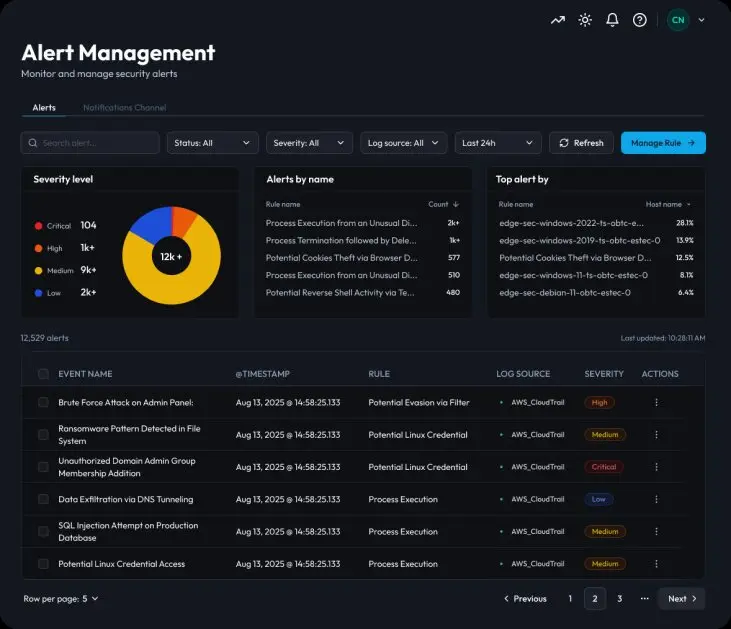
Our responders work on the same platform already watching your estate. The case opens with the timeline, the IOCs, the affected hosts and accounts, and the investigation tasks already in it. No scramble to pull logs out of six teams first.
Not a monitoring client? We still take the call. The first job then is standing up emergency collection, so there's something to investigate.
One technical lead is assigned to you. NDA signed. We tell you what to do now — and what not to do, so the evidence survives.
Ransomware, BEC, data theft, insider misuse. Which systems are in scope.
How they got in. How they moved. What they touched. Whether data left.
You approve the containment plan before we run it. We don't cut production systems on our own authority.
Findings, prioritised remediation, and new detections deployed into monitoring so the next attempt surfaces sooner.
What happened, how far it went, what evidence backs that. Technical detail goes in the appendix, not the summary.
Ready to sweep the rest of your estate, and ready to hand to a partner or a regulator if it comes to that.
Including the new detections already live in monitoring, so you can show the gap is closed, not just logged.
Data encrypted, usually with a threat to leak it.
A mailbox taken over to redirect payments or read quietly.
Customer or internal data taken out of the estate.
A vulnerability exploited to plant a backdoor.
Legitimate access used for something it wasn't granted for.
A supplier is compromised and it reaches you.
The alert is not the intrusion. It's the first thing that happened to be visible — and it's late.
Every hunt re-runs across retained data — which is how an exfiltration spread thinly over a fortnight gets found at all.
Alerts sharing an entity fold into a single campaign instead of forty tickets that each look minor.
One hop of the entity graph comes attached, so lateral movement is visible rather than reconstructed.
Malware on a payment host means segmentation, jump host and application auth were already crossed. The case says which — and that says where to look next.
It performs the steps an analyst repeats identically every time:
An analyst decides. The AI does not contain, isolate, disable or block.
Every step it took is recorded in order and can be replayed — you audit its work, not just its conclusion.
Control-plane and audit trails normalised like any endpoint log, so a cloud step and a host step land on one timeline.
Cluster audit, workload events, runtime security, and the virtualisation layer under them. A pod that is gone cannot be imaged — collection is continuous, not reactive.
Windows, Linux, macOS, firewalls, proxies, VPN, directory, network sensors. No central logging? We collect with the free forensic toolkit and replay it into the same pipeline.
The limits matter more than the claim — see below.
OT, ICS and IoT. We work where OT incidents are actually investigated: the IT side of the boundary.
What we don't claim. ICS protocol content — Modbus, DNP3, S7comm, IEC-104 — is not parsed into detections. ICS network visibility reaches us through the IDS feed; safety-instrumented systems are out of scope.
In one. Call the hotline. We take the call first and do the paperwork after.
Not in one. Start with a log coverage assessment. Fixed scope, fixed duration. The findings will tell you what to do next — including when the answer is "you don't need a managed SOC yet."


 Pulls the context around the alert — that user, that host, either side of it